Recycling Technology & Material Recovery
Material recovery relies on high-speed industrial separation. Mixed commingled waste cannot be directly melted or extruded. Purity targets require advanced optical sensors, ballistic trajectories, and density baths.
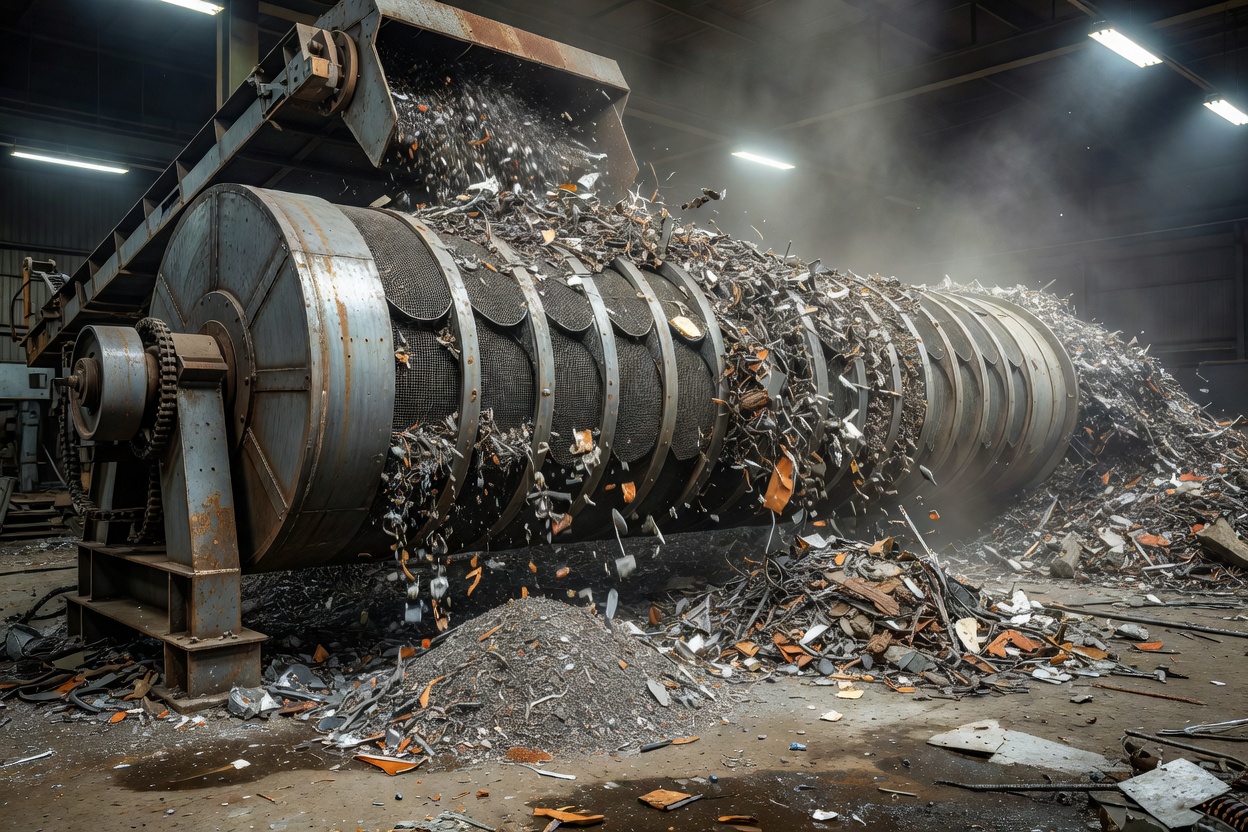
The Mechanics of Material Separation
Municipal and industrial waste streams arrive as commingled masses. Before any re-pelletizing or re-smelting occurs, fractions must be isolated to purity levels exceeding 98%. Contamination causes catastrophic structural failure in secondary engineering parts.
Modern European recovery facilities use multi-stage mechanical sorting lines. Materials pass through physical screens, magnetic fields, high-speed camera sensors, and pneumatic ejectors within seconds.
Core Separation Technologies
Modern material recovery facilities (MRFs) organize equipment into standardized sequential stages:
- Trommels & Ballistic Separators: Rotating cylindrical sieves and angled oscillating paddles separate rigid three-dimensional containers from lightweight flexible films based on rolling dynamics and mass.
- Over-Belt Magnets & Eddy Current Rotors: Permanent magnets lift ferrous steels. Rapidly alternating magnetic fields in eddy current separators induce repulsive currents in non-ferrous aluminum cans, ejecting them forward off conveyor belts.
- Near-Infrared (NIR) Optical Sorting: Infrared emitters illuminate plastic packaging. Sensors detect specific molecular absorption signatures (PET, HDPE, PP, PS) and signal high-speed compressed air nozzles to blast matching bottles into separate chutes.
- Sink-Float Flotation Tanks: Shredded polymer flakes are submerged in water baths with controlled specific gravity. Polyolefins (PE, PP) float with a density under 1.0 g/cm³, while PVC and PET sink, enabling clean micro-separation.
Closed-Loop vs. Open-Loop (Downcycling)
Not all recycled material re-enters its original application. The structural difference dictates long-term material value retention:
| Characteristic | Closed-Loop Recycling | Open-Loop (Downcycling) |
|---|---|---|
| Target Outcome | Bottle-to-bottle, can-to-can | Fleece textiles, park benches, highway asphalt filler |
| Quality Retention | Near-virgin mechanical tensile strength | Substantially decreased melt-flow index and flexibility |
| Subsequent Cycles | Capable of multiple sequential loops | Final lifecycle stage; usually unrecyclable after downcycling |
| Purity Threshold | Requires over 99% pure mono-stream | Tolerant of multi-polymer mixtures and color additives |
Processing Constraints in Secondary Polymers
Recovering thermoplastics involves persistent chemical challenges:
- Thermal History Degradation: Extruding plastic requires temperatures above 200°C. Each heat cycle breaks long polymer backbones into shorter fragments, reducing mechanical impact resistance.
- Black Pigment Invisibility: Standard near-infrared sensors cannot read carbon-black pigment, which absorbs all infrared light. Unsorted black plastics bypass detection and end up in incinerator residual bins.
- Multi-Layer Barrier Films: Food pouches containing laminates of polyamide, aluminum foil, and polyethylene cannot be separated economically through sink-float processes and choke mechanical wash lines.
- Volatile Organic Compound (VOC) Retention: Recovered consumer plastics absorb residual fragrances, oils, and detergents. Stripping these odors requires high-vacuum degassing, significantly increasing facility operating costs.
Good For
- Rigid unpigmented HDPE milk containers and transparent clear PET bottles.
- Ferrous scrap metal and continuous non-ferrous aluminum packaging.
- Clean, unlaminated corrugated cardboard shipping boxes.
- Post-industrial clean trimmings directly reclaimed at the factory gate.
What to Know
- Chemical recycling (pyrolysis) remains energy-intensive and produces heavy carbon residues.
- Commingling glass with paper fibers embeds micro-shards that damage paper mill rollers.
- Biodegradable plastics (like PLA) contaminate conventional PET sorting streams.
- Secondary resin must compete on cost with virgin crude-oil-derived feedstocks.
Inquire on Secondary Material Yields
Our European desk assists processing engineers with mechanical separation criteria and optical sorting profiles.
Contact Atlas Operations